Document & Video
From Textbook to Multimedia: Introduction to the Constitution
A traditional unit introduction adapted into a narrated video launch with transcript and questions.
Source: Pages 4–6 of the NYS Unit Plan
The “Historical Context for Teachers” pages provided to Gemini as source material for the video.
Original artifact
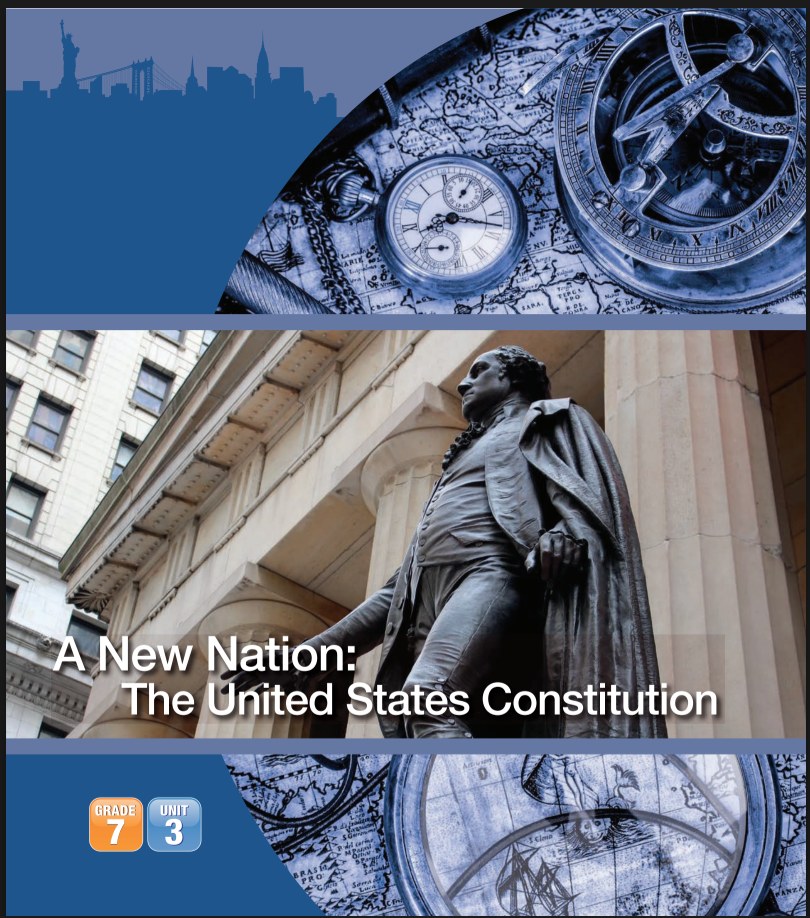
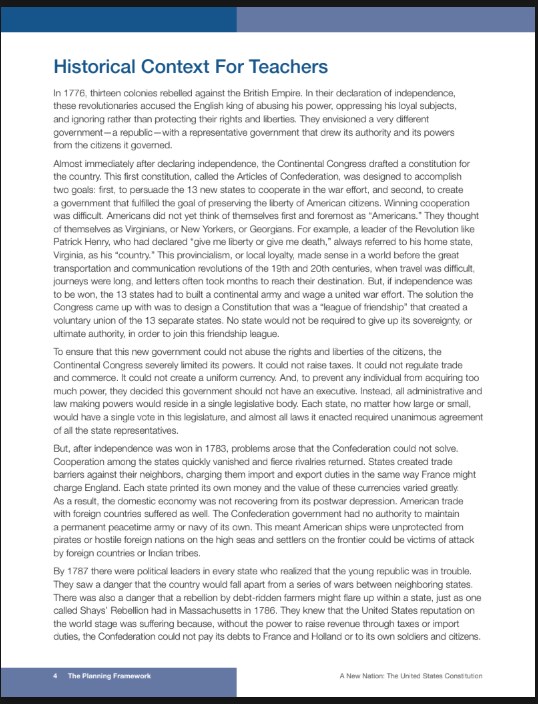
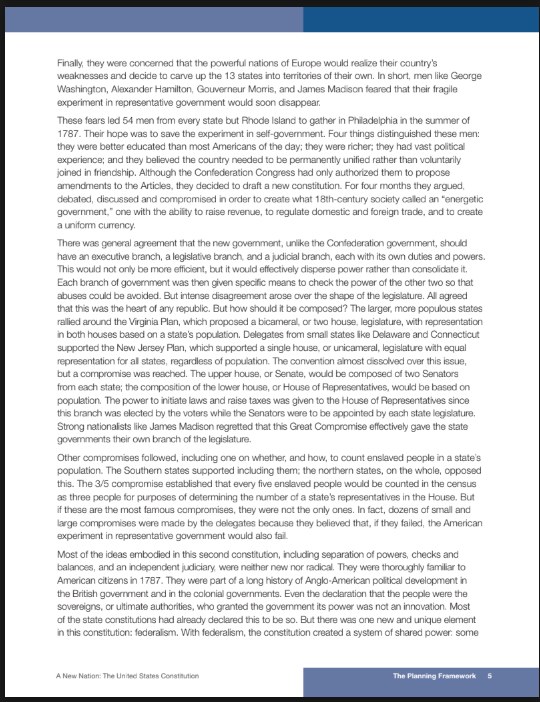
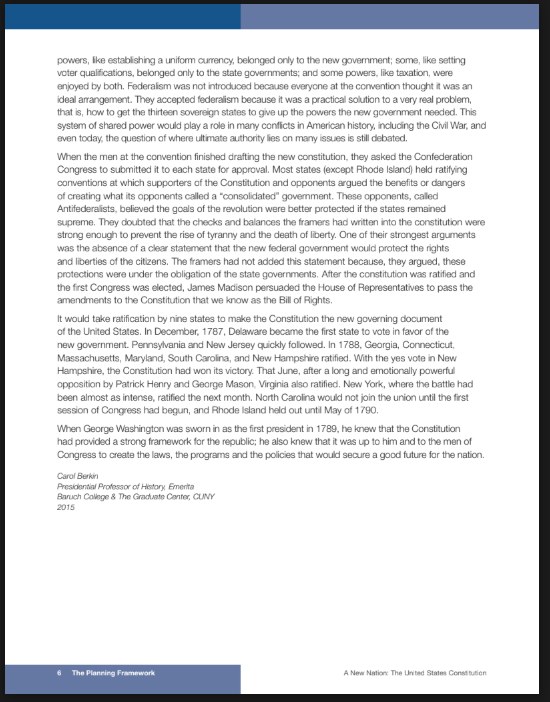
Click either side of the page, use the arrows, or swipe to turn.
Multimedia Adaptation
The full unit introduction (pages 4–6 of the NYS unit plan) was used as source material in Gemini to generate this narrated video launch.
Supporting video transcript and student questions
Part 1: The First Attempt (The Articles of Confederation)
So, how do you build a nation from scratch? This is the story of the United States Constitution — and it starts not with a huge success, but with a massive failure that almost tore the new country apart before it even had a chance to get going.
America's very first government was a total disaster. Imagine winning a revolution against the most powerful empire on Earth, only to find that the country you just fought for is already on the verge of complete collapse. That's exactly where the founders found themselves, because their first blueprint for a nation was deeply, fundamentally flawed.
Right after declaring independence, the founders' number one priority was to create a government that was the exact opposite of the powerful king they had just kicked out. Their first shot at a rule book was called the Articles of Confederation. Coming fresh out of a brutal war with a king they saw as a total tyrant, their main goal was to make sure that could never happen again — so they designed a government that was intentionally, almost fatally, weak.
The whole idea of being an "American" was brand new. People saw themselves as Virginians first, or New Yorkers first. Their loyalty was to their home state. That led them to create what they called a "League of Friendship," which was less a unified country and more like a loose club where each state was basically its own boss.
- Who were the “Founding Fathers”?
- Why did the Founding Fathers want to create a weak government?
- Why did people see themselves as New Yorkers or Virginians, but not Americans?
- What was the “League of Friendship”?
Part 2: The System Fails
Designing a government to be weak started to backfire big time. The central government was, for all intents and purposes, completely powerless: it couldn't collect taxes, so it was always flat broke; it couldn't control trade, so states got into economic fights with each other; it couldn't even create one single currency.
There was no president to give direction. With no money to raise an army or a navy, American ships were sitting ducks for pirates. States were starting little trade wars against each other. And to get any major law passed, you needed all 13 states to agree unanimously.
The final wakeup call came in 1786 with Shays' Rebellion, when frustrated farmers took up arms in Massachusetts. The national government was too weak to do anything about it. That was the moment everyone realized the experiment was failing.
- What were some problems with the initial government the Founding Fathers created?
- Why did Shay’s Rebellion show that the new government wasn’t working?
Part 3: The Constitutional Convention
By 1787, it was obvious this wasn't working. Leaders like George Washington were writing letters saying the country was falling apart. So they called a meeting in Philadelphia. The original idea was just to patch up the Articles, but they quickly realized it was beyond repair — they scrapped the entire system and started over.
Their new goal was an "energetic government" — one with the power to tax, regulate trade, and defend the nation. Their genius solution was Separation of Powers: Congress to make the laws, the President to carry them out, the Courts to interpret them — a permanent three-way check so no single branch could get too powerful.
- Why did the Founding Fathers decide to start over with a new government?
- What were some of the Founding Fathers’ goals for the new government?
- What are the three branches of government and what is the main job of each?
Part 4: Compromise and Conflict
Agreeing on this new system was anything but easy. The single biggest fight came down to Representation: big states wanted representation based on population; small states demanded every state get an equal vote.
The solution was the Great Compromise: a Congress with two houses — the Senate (every state gets two senators) and the House of Representatives (reps based on population). Not all compromises were great, though. The fight over whether to count enslaved people toward a state's population produced the infamous Three-Fifths Compromise, which gave the southern states far more power in Congress than they should have had.
- Why did big and small states disagree about representation?
- What house of Congress made the big states happy? Why?
- What house of Congress made the small states happy? Why?
- What did the southern states like about the Three-Fifths Compromise?
- What did the northern states like about the Three-Fifths Compromise?
Part 5: Ratification and the Bill of Rights
After months of grueling debate, the founders had a new constitution on paper — but now they had to sell it to the country. Two groups formed: the Federalists, who argued a strong central government was essential; and the Anti-Federalists, who feared this new government would end up crushing their hard-won freedoms.
The compromise that won the country over: a promise that the very first thing the new government would do is add a Bill of Rights — a guarantee of individual freedoms. In 1789 the new government launched, and George Washington was sworn in as the first president.
The founders knew the Constitution wasn't perfect. It was a starting point, born from fierce debate and compromise — with the hard work of making it succeed left to every generation that came after.
- What were Federalists?
- What were Anti-Federalists?
- What was (and is) the Bill of Rights?
- Who was the first American president?
Glossary
- Blueprint: A design or plan for how something should be built or organized.
- Centralized: Power or control gathered in one place or under one authority, rather than spread out.
- Compromise: An agreement where each side gives up something they wanted in order to meet in the middle.
- Convention: A large official meeting or conference.
- Currency: The system of money used in a particular country.
- Divisive: Something that causes a lot of disagreement or hostility between people.
- Energetic Government: A term used by the Founders to describe a government active and strong enough to get things done.
- Ratify / Ratification: To formally approve or confirm, especially by vote.
- Separation of Powers: Dividing government power into different branches so no one person or group has too much control.
- Tyrant: A cruel and oppressive ruler who uses power unfairly.
- Unanimously: When everyone involved is in full agreement.